
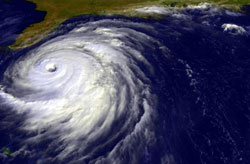
 The term hurricane is derived from Huracan, a god of evil recognized by the Tainos, an ancient aboriginal tribe from Central America.
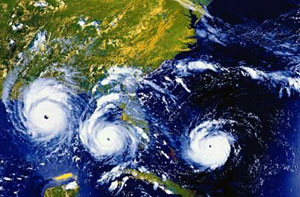 Hurricanes are often described as a heat engine. The Energy that drives a hurricane comes from solar heat that was stored in the ocean . The hurricane sucks in warm, humid air from the lower atmosphere. The air was heated by the sun and moisture from the sea has evaporated into the air. As the air is warm it rises and the water vapor condenses, releasing the heat energy that the moisture absorbed as it evaporated from the ocean.
The storm exhausts its supply of heat (water vapor) when it moves over land or colder water.
Hurricane intensity is based upon the highest sustained (1 minute average) wind speed the hurricane is producing. The "Saffir-Simpson" scale rates hurricane strength in this way from Category 1 to Category 5. These categories were chosen based upon the amount of damage that each category can produce.
| Intensity | Wind Speed | Damage |
| Category 1 | 74- 95 mph | MINIMAL: tree branches, shrubs, minor pier damage |
| Category 2 | 96-110 mph | MODERATE: mobile homes, some trees down |
| Category 3 | 111-130 mph | EXTENSIVE: small buildings damaged, large trees down |
| Category 4 | 131-155 mph | EXTREME: outer walls damaged, roof failure on small buildings, mobile homes destroyed |
| Category 5 | >155 mph | CATASTROPHIC: complete roof failure on many buildings, some buildings destroyed |
As winds increase to 63 kilometers (39 miles) per hour, storm receives a name. This tradition started with the use of World War II vintage code names such as Able, Baker, Charlie, etc. In 1953, female names were used exclusively until the late 1970s, when storm names began to be alternated between male and female names. Hurricanes are the only weather disasters that have been given their own names. The man who first gave names to hurricanes was an Australian weather forecaster named C. Wragge in the early 1900s. Sometimes names are "retired" if a hurricane has been really big and destructive. Retired names include Katrina, Andrew and Mitch.
In a day, a hurricane can release an amount of energy equal to all of the electricity the entire world can generate in 200 days! Source A fully developed hurricane can release heat energy at a rate of 5 to 20x1013 watts. This heat released is equivalent to a 10-megaton nuclear bomb exploding every 20 minutes.
A hurricane can release more energy in its life cycle than 10,000 nuclear bombs. Source Source 2
Most hurricanes rage harmlessly in the sea.
Hurricane season in the Atlantic Ocean runs from June 1 to November 30.
The first time anyone flew into a hurricane happened in 1943 in the middle of World War II.
The difference between a tropical storm and a hurricane is wind speed – tropical storms usually bring winds of 36-47 miles per hour, a tropical storm will be classified as a hurricane once winds goes up to 74 miles per hour or higher.
The most violent winds and heaviest rains take place in the eye wall, the ring of clouds and thunderstorms closely surrounding the eye.
In the Pacific Ocean, Hurricanes are generally known as typhoons. In the Indian Ocean they are called tropical cyclones.
When they come onto land, the heavy rain, strong winds and heavy waves can damage buildings, trees and cars. The heavy waves a hurricane brings are called the storm surge. Storm surges are very dangerous and the cause of most hurricane related deaths.
 References:
http://earthobservatory.nasa.gov/Features/Hurricanes/
http://www.aoml.noaa.gov/hrd/tcfaq/tcfaqHED.html
http://environment.nationalgeographic.com/environment/natural-disasters/hurricane-profile/
http://hurricane.accuweather.com/hurricane/facts.asp
http://en.wikipedia.org/wiki/Hurricane
http://www.ready.gov/know-facts